History
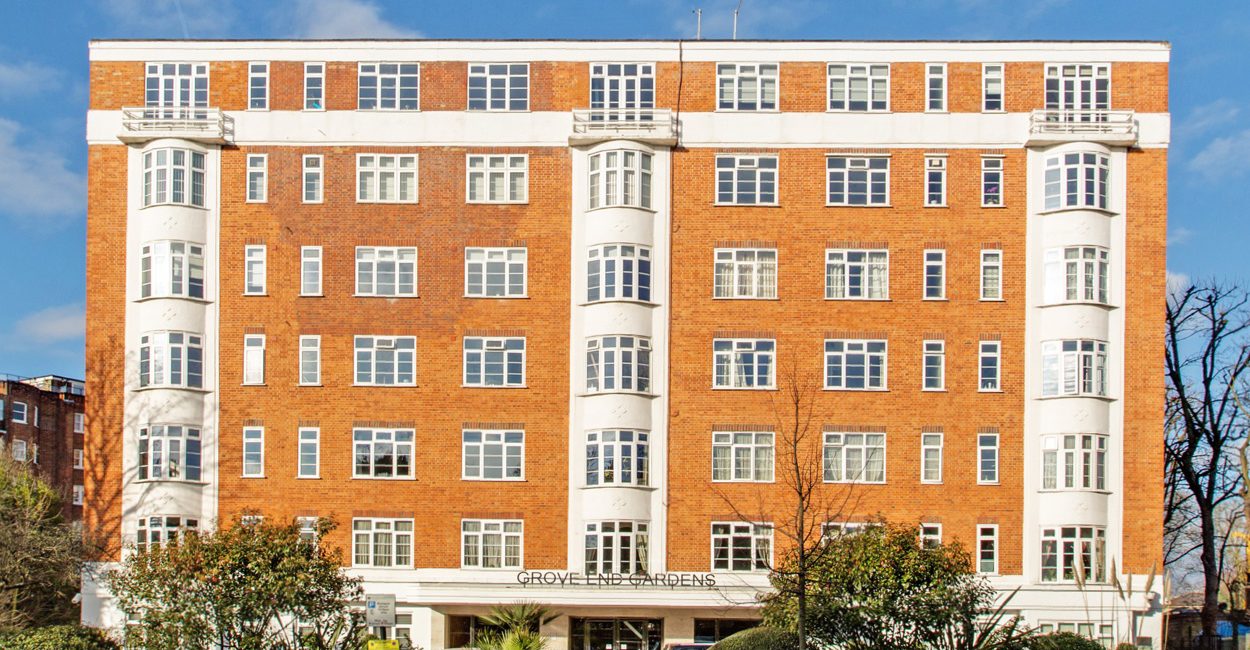
Grove End Gardens in Grove End Road will be well known to those who live in St John’s Wood, and probably feels like it has been here forever. However, the building is still less than a century old. Its site had previously contained a number of detached and semi-detached properties that were constructed by the Eyre Estate in the 19th century.
Enter Sir John Mactaggart (1867 – 1956). He was a very successful builder and developer in Glasgow. In the early 1930s, Mactaggart turned his attention away from Glasgow to the London property market. In 1931 he assembled the site on Grove End/Abbey Road where Grove End Gardens now sits. In an unusual twist, in order to support the financial independence of the women in the family, the original owners of the site were “The Ladies Syndicate”, comprising Betty Mactaggart (Sir John’s wife) and other lady members of the Mactaggart and Mickel families.
The assembled plot covered almost two acres, but the area to be covered by building was just 34% of the site (29,244 sq ft). Grove End Gardens was completed in 1935, designed by architect Joseph Wilson of Glasgow – it is believed that Grove End Gardens is his only London building.
The building is constructed in ferro-concrete with facing bricks, rising to seven storeys. The flats originally had 2, 2½, 3 or 4 rooms, together with a kitchen and bathroom. There were waste disposal systems with a vertical chute for each flat. Altogether there were 268 separate flats of different sizes. There were communal facilities, including a reception room on the ground floor and squash courts on two upper floors. The gardens were extensive and to be enjoyed communally by the residents. The gardens were located away from the traffic and planted with a variety of trees, all now mature specimens.
Flats in Grove End Gardens were developed as affordable properties for professional people, having small kitchens but with a club, restaurant and a bar on the ground floor. Being small size, the flats were not ideal for large families. Initially the residents were predominantly from a well-educated lower to middle-class background, some of them refugees.
During World War Two it was said that as the shell of the block was solid concrete, people used to sleep in the corridors to avoid the air raids. During the War, the building received one direct hit, but was largely undamaged.
In 1967 the Grove End Housing Association was established as an independent property company with Grove End Gardens as its main asset. Since then the company has significantly upgraded its accommodation to modern living, including double glazing throughout, enhanced porterage, new entrances and an underground car park. Following the dreadful Grenfell fire, the front doors of every flat were replaced with fire-resistant doors.
In 2024 the company converted to a Company Limited by Guarantee, a more appropriate form for its current activities of, firstly, providing good quality accommodation in the two properties, and secondly in donating significant sums to UK charities each year.